
Marion Harper
For Marion Harper
Jan Bryant Art Programme
Acts of Incline @ GALLERYSMITH
February 26—March 21, 2026.
Acts of Incline
Layer 1 (A First Encounter)
Acts of Incline is a series of paintings by Marion Harper, arranged in pairs. The paintings are part of an ongoing interrogation into the way bodies are held in space. Sentient or inanimate, these bodies, these objects, reveal the vital relation between ground and gravity. In preparation, Marion photographs moving figures with an iPhone, rendering the images in pencil and pen, to finally submit them to the decisions and methods belonging uniquely to painting.
For this series, Marion set an ambitious goal: to convey the vital experiences under which her anonymous ‘subjects’ are living, especially phases of life that elicit feelings of uncertainty. Anthropologist[1] designate these passages and subjectivities as “liminality or liminal personae (threshold people).”[2] Liminality is “neither here nor there” but “a betwixt and between.”[3] The term was developed to address those who fall outside classification: neophytes, those on the cusp of puberty, adulthood, and so on.[4] In anthropology, liminality is disorientating. In reference to Acts of Incline, Marion explains: “Bodies lean, angle, and reorient; they negotiate gravity, architecture and furniture to locate new positions from which to sense and think.”[5]
(Dis)orientating (Re)orientating...
Teetering somewhere along the axes of intoxication and sobriety, or injury and recovery (imagine the impact of rapid, vertiginous falls and slow, replenishing convalescences) Marion posits “disorientation [as] a way to imagine new relations, new spaces, and new ways of feeling embodied.”[6]
As Western free-market capitalism began to expand after World War II, heading into the abyss of neo-liberal, trickle-down economics, the Situationist Internationale [SI] (1957–1972)[7] proposed that cities were being reorganised in support of capitalist ideologies.[8] They criticised the complicity of urban planners and architects to facilitate the movement of workers and capital through ‘efficient’, ‘functional’, and ‘orientating’ buildings and streets. A vital tactic of resistance for the group was to promote ‘disorientating’ spaces, maize-like rather than constraining. As self-proclaimed New Babylonians,[9] they once asked what it would be like to navigate the streets of Paris using a map of Amsterdam. They envisaged the thrill of wandering aimlessly through labyrinthine structures, free from the inculcating ways of modern capitalism.[10]
Stillness, Hope…
In the manner of a single film frame, excised from its larger whole, Acts of Incline shows figures teetering in the midst of movement. We can imagine the next frame, it would be another still image, slightly advanced, but soon to disappear into the flow of animation. I have run off with this image of a moving body (that no longer moves) to underpin the possibilities offered by the intensified stillness trapped in Marion’s paintings. With actions being fixed, this is also the suspension of predictability. Multiple and unknown futures are poised (virtual) ready to be actualised. This is an approach that respects (as in the thought of Henri Bergson),[11] a moment of heightened optimism for non-predetermined ways forward, an opening to an enlivened future.
And since this is painting beyond representation…[12]
…to transmit the physical and psychological effects of disorientating bodies, Marion’s ambition for Acts of Incline is to experiment with surfaces that resonate (vibrate) with sensational affect. This is a tactic to synthesise her conceptual ambitions and painterly skills. Wary of the ethical and philosophical limitations of representation,[13] Gilles Deleuze and Felix Guattari concluded that: “The work of art is a being of sensation and nothing else.” Bubbling underneath Marion’s conceptual concerns is the idea that sensation, as “the unthinkable in thought,”[14] forces a cognitive shift, an understanding or processing that moves from affect to thought.
Such a transition is capable of not only conceiving of the new, but also opening to a sense of hopefulness.[15] “It is not contentment or ‘happiness,’ but rather the vitality and mobility that is the only true antidote to melancholy as affect of an unattainable idealisation or ‘hope’ —thus [sensations] rewire the nervous system, revitalise the brain, releasing us, in mind as in body, from the heaviness of grounded identities and habitual forms.”[16]
Layer 1 (a first encounter) finds subjects in the throes of bodily/nervy movement (somewhere) between steadiness and dizziness, plasticity and tautness, frailty and strength. To be overrun by sensations, is to be disorientated, offering a possible rewiring that may lead to hopeful of and non-predetermined future.
Layer 2 (Colour)
Each pair that comprises Acts of Incline is bound by a limited palette, producing a subtle chromatic effect that fades or pulsates across the surface. Often this occurs at the edges of the objects so that the surrounding spaces appear as fields of dusty, downy tints, allowing the bodies and objects to bounce out of darker or lighter fields.
Marion treats colour “not as an event” (in the way colour has the tendency to subjugate all that it touches) but as a way “to register atmospheric or bodily sensations.” High-chroma pigments (with poetic names) were chosen:
Cadmium reds and yellows
Prussian blue,
Ultramarine blue,
Vermilion,
Alizarin crimson,
Burnt umber,
Sap green,
Viridian green
Cobalt violets.
Come Out (2025) depicts a ‘silvery’ object hanging above a groundless-black-ground. It seems to be made of thin flexible metal, etched with horizontal black lines. Perhaps it was once a Lissajous figure (b/a = 2, δ = π/4) twisted into an unruly form. Now misshapen, the object looks like space junk floating through a black universe, an infinite abyss of no return.[17] Marion mixes her blacker-than-blacks out of three colours — Prussian blue, Alizarin crimson and Burnt Umber.[18] As a non-painter, falling somewhere between nescience and ignorance, I was enthralled by this rich, pristine black that came not directly from a tube but from Marion’s alchemical ways.
Come Out is the painting pair of Between Standing and Falling. It shows a figure of a woman dressed in a black pin-striped suit. The stripes echo the dark etching on the metal object from Come Out, while the black suit of Marion’s dancer is dense but slightly diffused by the white pin stripes. Marion has painted the figure mid-movement, falling backwards. She is near a corner wall, her hands gripping the wall behind her. The pale bluey-grey walls and the darker greeny-bluey-greyish floor act as screens for the projection of shadows seeming to come from multi-directional light sources. The shadows are buckling, like the dancing figure and the metal object.
Wandering alliances… literature / music / performance…
Equivalent hues, forms, lines, and painterly surfaces—Marion has applied a high level of precision and care to bring the works in Acts of Incline into alliance. This makes me think of the luscious, overwrought prose of J-K Huysman and his fictional character, the (hyper)aesthete, Jean Des Essientes. With disgust for ‘ordinary’ tastes, Des Essientes, arranges with vigour a black dinner party (in homage to his lost virility):
A more conscious connection, this time to Marion’s lolloping figures, is her naming of Come Out after a score by the composer Steve Reich. Come out (1966) is a collage arrangement of minimalist sound in support of the Harlem Six. This was a controversial case of injustice and racism in New York against young black men accused of murder in the 1960s. Come Out uses a tape-loop of the voice of Daniel Hamm (one of the Six).
In 1982, the score, with permission from Reich, was used by the choreographer Anne Teresa De Keersmaeker for her performances, Fase: Four Movements to the Music of Steve Reich. Come Out is the third instalment for two ‘movers’ wearing Loïe Fuller-like white dresses (floaty, billowy).[20] They perform repetitive arm and leg throws while progressing through dark, black space.
In Layer 2 (Colour), the intention for probing the colour implications of one painting-pair from Acts of Incline was to show the broad connections that underpin the series. But as with wandering thoughts, the connections (possibly endless) were brought to an abrupt end. It is a little like the lazy prospector who traverses the earth around old gold mines, hoping to capitalise on the toil of others and their forgotten scraps. Only a morsel of Marion’s rich and broad thinking has been retrieved.
Layer 3 (substrate Quercus)
Acts of Incline is a series of oils on Quercus (oak), chosen for its irregular grain.
As a distracted guest of forests and an unfocussed visitor of interiors swathed in wood, this revelation brought happy thoughts about the wonderment of specialists and their secrets: the knowledge of the artist, the furniture maker, the antique expert... This is not the world of a lofty, judgy connoisseur who lords over the opinions of the ‘rabble’ with a superior air. But for those who form intimate connections with the obscure details of a thing. Such love for the specialist who loves obsessively.
Marion chose the uneven grain of oak for its “capacity to instil a greater sense of movement, than, say, the more regular grain of birch.”[21] A lovely detail, this substrate lying under images of moving, unsteady figures (now stilled in paint). The grain is not visible from a distance, nor discernible in painting’s distant digital cousin. This is what separates painting from the technologies that reproduce it. The grain of woods, the textures of canvas, the movements of brushes.
I imagine that a specialist has disdain for the brutality of generalisations, for a failure to account for the differences of a multitude of unique species and their grains (their designs, colours, leaves, fruits, flowers, nuts, their hidden nourishing roots). Sustainable American Oak grows more strongly in a forest than as an isolated tree in a field. “Trees are social beings that share food and nutrients and live best in communities (forests).”
This seems an apt metaphor for Marion’s entanglement of methods and relations that were crucial in the materialising of Acts of Incline: her models, their contorting poses, her unexpected colours from unexpected mixtures, her use of digital technologies (photos and computer aided drawings), pencils, pens, and the wooden substrate of American oak.
Layer 1(First Encounter) + Layer 2 (Colour) + Layer 3 (Substrate) are three sections sliced (perhaps a little arbitrarily) from the whole. They were chosen to show how Marion’s alchemical wizardry permeates Acts of Incline as a swirl of effects that oscillate between the poetic and the prosaic, balancing technical (precision) with conceptual coherency.
Jan Bryant
Art Programme
________________________
[1] See especially Arnold van Gennep, Les rites de passage (The Rites of Passage, 1909) And Victor Turner, .The Ritual Process: Structure and Anti-Structure , (New Jersey: Aldine Transaction, 1969) .
[2] Victor Turner; Roger Abrahams; Alfred Harris, The Ritual Process (New York: Routledge, 2017) 95
[3] Ibid.
[4] Perhaps we may chuckle in the 21st century, and perhaps a little smugly, at the attempt to snare all sensate beings into hierarchical systems, to classify that which has been described as non-classifiable,
[5] Marion Harper, “Exhibition Brief,” Merricks, Victoria, December, 2025.
[6] Ibid.
[7] The Situationist Internationale were formed in Alba (Italy) in 1957 from various European avant-garde art movements, such as the Lettrists and CoBrA, The (SI) was focused on an anti-capitalist agenda. The group formerly dissolved in 1972.
[8] A particular target of the SI was the Congrès Internationaux d’Architecture (The Congress of Modern Architects or CIAM). This was a body of influential architects and designers (including Le Corbusier, Walter Gropius, and Alvar Aalto) that had been established in 1928 following a bitter dispute over the shape of the new League of Nations building in Geneva. Criticism of the design ideology that conflated modernism with purism was not confined to the SI. Throughout the 1950s, generational divisions in CIAM grew, as younger members became increasingly hostile, judging the organisation as over-dependent upon notions of rationality, reductionism and functionality. Formed under the name Team 10 and comprising of Aldo van Eyck, Jacob Bakema, H.P. Daniel van Ginkel, Hans Hovens-Greve, Peter Smithson and John Voelker, the group distributed the Doorn Manifesto in 1953 —– a charter on habitation. The aim was to directly oppose CIAMs’ Athen’s Manifesto (1933) that organised the ‘ideal’ city into four ‘functional cells’: dwelling, work, recreation and circulation.
[9] Constant Nieuwenhuys, a Dutch member of SI, created evolving models for imaginary, mobile cities called New Babylon, in which the inhabitants, no longer needed to work, using play and technology as catalysts for permanent transformation. Constant worked on the project until his death in 2005.
[10] This method is known as Dérive (to drift) / Dériver (to divert). The aim is to engage with the revolutionary potential suspended in a city’s social and physical structures. The dérive was designed to capture potentially disruptive gaps and spaces in the capitalist city as a foundation to resistance:
In a dérive one or more persons during a certain period drop their usual motives for movement and action, their relations, their work and leisure activities, and let themselves be drawn by the attractions of the terrain and the encounters they find there. The element of chance is less determinant than one might think. From the dérive point of view cities have a psychogeographical relief, with constant currents, fixed points and vortexes which strongly discourage entry into or exit from certain zones. [Guy Debord, “Theory of the Dérive” Internationale Situationist, #2, December 1958].
[11] Henri Bergson, Matter and Memory (1896) (trans.) Nancy Margaret Paul and W. Scott Palmer. (London: George Allen and Unwin, 1911).
[12] Taken from the title of an article by the Deleuzian art theorist, Simon Sullivan, “Aesthetics of Affect: Thinking Beyond Representation”, Angeliki, vol, 6, no.2, December 2001, 125–134.
[13] In Difference and Repetition, Deleuze writes: “The work of art leaves the domain of representation to become' experience' (or 'experiment'), transcendental empiricism or science of the sensible." (trans.) Paul Patton (New York: Columbia University Press, 1994) 56.
14 Gilles Deleuze and Felix Guattari, (trans.) Hugh Tomlison, What is Philosophy, (New York: Columbia University Press, 1994) 164.
15 Gilles Deleuze, Cinema II: The Time Image, (trans.) Hugh Tomlinson; Robert Galeta (Great Britain: The Athlone Press, 1989) 168.
16 John Rajchman, Deleuze Connections, (Cambridge, Mass; London, UK: MIT Press, 2000) 138-9.
17 Come out (2025) and Between Standing and falling (2025),172 x 60 cm
18 Studio discussions with Marion (Merricks, 22 December 2025).
19 J.K. Huysman, Against Nature (À Rebours) 1884) (trans.) Robert Baldick (1951) (London: Penguin. 2001) 13
20 Loïe Fuller was an American born dancer-choreographer considered a pioneer of contemporary dance and the use of expressionistic stage lighting
21. Studio Interview, December 2025
22 Peter Wolleben, The Hidden Life of Trees: How they Feel; How they Communicate—Discoveries from a Secret World (Melbourne: Black Inc. Books, 2016)
Out of black-edged plates they had drunk turtle soup and eaten Russian rye bread, ripe Turkish olives, caviar, smoked Frankfort black pudding, game with sauces that were the colour of liquorice and blacking, truffle gravy, chocolate cream both intricate and meticulously, puddings, and nectarines, grape preserves, mulberries and black-heart cherries; they had sipped, out of dark glasses, wines from Limagne, Roussillon, Tenedos, Val de Penas and Porto, and after the coffee and walnut brandy had partaken of kvas and porter and stout. [19]
When trees grow together, nutrients and water can be optimally divided among them all so that each tree can grow into the best tree it can be. If you ‘help’ individual trees by getting rid of their supposed competition, the remaining trees are bereft. They send messages out to their neighbours in vain, because nothing remains but stumps. Every tree now muddles along on its own, giving rise to great differences in productivity. Some individuals photosynthesize like mad until sugar positively bubbles along their trunk. As a result, they are fit and grow better, but they aren’t particularly long-lived. This is because a tree can be only as strong as the forest that surrounds it. And there are now a lot of losers in the forest. Weaker members, who would once have been supported by the stronger ones, suddenly fall behind. Whether the reason for their decline is their location and lack of nutrients, a passing malaise, or genetic makeup, they now fall prey to insects and fungi. 22
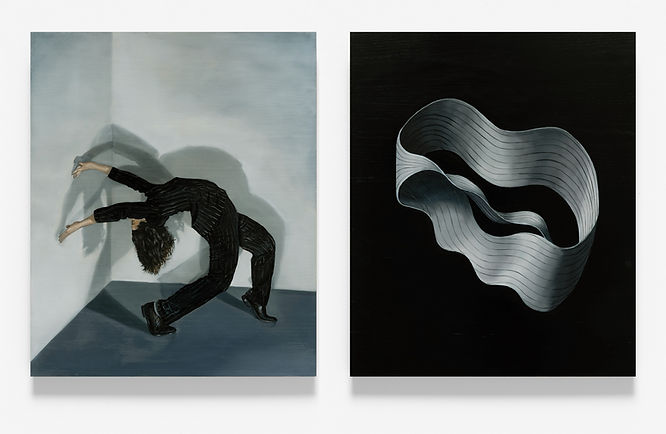
Pair left to right:
Between Standing and Falling, 2025, 71.5 x 59.5cm, oil on oak panel
Come Out, 2025 , 71.5 x 59.5cm , oil on oak panel